Dry foods can seem forgiving: rice, oats, coffee, and powdered ingredients sit quietly on shelves. Yet moisture, oxygen, light, pests, and rough handling can affect quality before a bag looks damaged. The right Dry Food Packages help manage these risks, but no single material suits every product. Small details matter.
The scale of food loss and waste is significant. FAO estimated that 13.2% of food was lost globally in 2021, between harvest and retail. UNEP’s Food Waste Index Report 2024 estimated 1.05 billion tonnes of food waste in 2022. Its estimate covers households, food service, and retail. Packaging alone cannot solve food loss or waste, and these figures are not packaging-performance measurements. Still, suitable packaging can help protect product quality during storage and distribution.
A package must fit the food, filling line, transport route, intended shelf life, and disposal system. Testing with the actual product is more useful than relying only on a glossy specification sheet. A careful evaluation considers barrier needs, seal integrity, pack format, material documentation, and clear end-of-life information. Some trade-offs remain. A stronger barrier may help preserve aroma, yet complicate recycling in some local systems. The seven tips below turn these questions into practical checks, from product compatibility to supplier evidence. They help teams choose carefully and revisit assumptions when results disappoint.
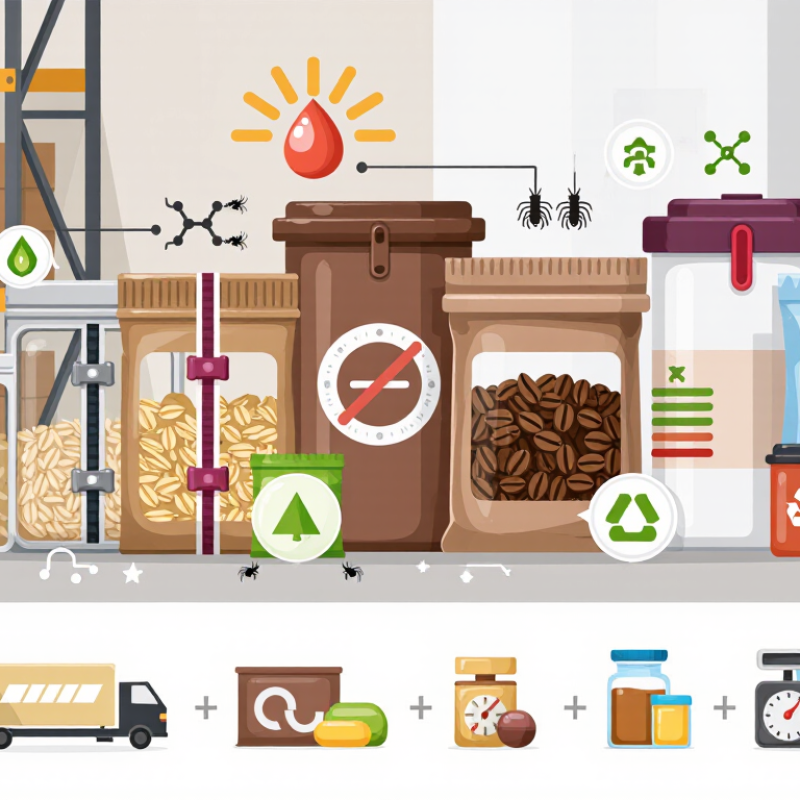
Assess Dry-Food Moisture Risk: Most Microbes Cannot Grow Below aw 0.60
Dry food can feel completely safe when it looks crisp, but appearance does not reveal its water activity. Water activity, written as aw, measures water available for microbial growth. It is not the same as total moisture content. Most microorganisms cannot grow below aw 0.60, though that figure should be treated as a general guide, not a product-specific guarantee. A dry-looking powder can still pick up moisture during storage. Small changes matter. Check the product’s aw with suitable, calibrated equipment, and follow a testing plan suited to the food.
Packaging helps keep that measurement from drifting. Choose materials with a moisture barrier that fits the product and its storage conditions. Inspect seals for wrinkles, pinholes, or weak edges, especially after filling. A good barrier cannot compensate for a poor seal. Keep packages away from damp floors, steamy kitchens, and repeated temperature swings that may cause condensation. I would not trust a crisp texture alone; it is an easy judgment to make, and an unreliable one. Recheck aw when ingredients, package structure, or storage conditions change, and record the results rather than relying on memory.
Set Oxygen and Moisture Barrier Targets Using ASTM D3985 and F1249
For dry food, barrier targets should begin with the product, not a convenient film specification.
Oxygen can dull flavors or promote rancidity; moisture can soften crisp pieces or cause clumping.
ASTM D3985 measures oxygen transmission through a material using a coulometric sensor.
ASTM F1249 measures water vapor transmission using an infrared sensor. Both results depend on test conditions.
Ask suppliers for the test temperature, humidity, specimen thickness, and reported units. A number without these details is hard to compare.
Set oxygen and moisture limits against the food’s sensitivity and intended shelf life, then check whether the proposed package can meet them.
Small differences matter. A thin film may perform well in a lab, while folds, seals, or pinholes create weak spots in production.
Test representative finished packs when possible, not just flat samples. That step can expose problems the material data misses.
Targets are estimates, too. Real storage conditions may be less tidy than the test chamber, so review results after shelf-life trials and revise assumptions when needed.
Choose Pack Size and Label Net Quantity Under FDA 21 CFR 101.105
Tip: Choose a pack size that matches how quickly you use the food. A small bag may stay fresher in a humid pantry, while a larger pack can mean fewer trips to the store. Check that it fits your shelf and can be closed securely after opening. Real kitchens are messy; the “ideal” size is not always the one you finish.
For dry foods sold by weight, the net quantity is the food’s weight, not the weight of its pouch, box, or other packaging. FDA regulation 21 CFR 101.105 sets requirements for this declaration. Look for it on the package’s principal display panel, the area most likely to face shoppers. It should be clear and easy to read. Placement and formatting rules can depend on the package, so avoid judging quantity from package height alone. A tall bag may contain less than it appears to.
Tip: Compare net quantities when choosing between pack sizes. If one package lists ounces and another lists pounds, convert them before comparing prices. Also check whether the label gives weight or a count; these describe different kinds of quantity. I still sometimes miss a small-print declaration, so I turn the package toward the light and read it twice. That extra moment helps.
Compare Material Strength Using ASTM D882 Tensile Testing
Dry food packages face pulling forces during filling, transport, and opening. A pouch that stretches unevenly may wrinkle or tear near a seal. Feel matters, but touch alone cannot compare films reliably.
ASTM D882 measures tensile properties of thin plastic sheeting under controlled conditions. A lab pulls a prepared strip until it stretches or breaks, recording force and elongation. Test samples in both machine and cross directions; films can behave differently across each. Short strips reveal useful details. Ask for film thickness, test speed, and conditioning notes, too. Results are hard to compare when those conditions differ. Small differences matter.
Review tensile strength alongside elongation at break and elastic modulus, rather than choosing the highest number automatically. A stiff film may resist stretching but feel less forgiving during packing. A more extensible film may stretch further, yet still need practical checks for handling damage. D882 does not measure puncture resistance, seal strength, or moisture protection. One limitation is easy to miss. Pair lab results with filled-package trials, including ordinary drops and shelf handling. Replicate tests also help reveal variation between samples; a single unusually strong strip can mislead.
Confirm Food-Contact Compliance and Verify Recycling Claims
A dry-food pouch can look sturdy and still be unsuitable for its contents. Ask the supplier for current food-contact declarations and relevant test reports, then check that they cover the exact packaging structure. The inner layer matters most: a pouch for oily nuts may need different evidence from one for dry rice. Confirm the intended food types, storage conditions, and temperature limits. Paper is not proof. Keep documents tied to material specifications and production lots, so a change in film or adhesive does not go unnoticed. One detail is easy to miss: ink and seals can matter too.
Recycling claims need the same scrutiny. Ask which components are included: the pouch body, zipper, label, and any clear window. Then verify that local collection and sorting systems actually accept that specific format. A package may be technically recyclable but not collected nearby. I still catch myself treating a recycling symbol as a clear answer; it is not. Look for substantiation from a credible testing or certification body, and check when the evidence was issued. Claims can age. If the supplier cannot explain the route from household bin to sorting facility, use narrower wording or leave the claim off. That may feel less appealing, but it is more dependable.
7 Tips for Choosing Dry Food Packages
Confirm food-contact compliance and verify recycling claims. EU packaging recycling rates vary by material, so check the package’s full structure and local recycling guidance.
EU packaging waste recycling rates by material, 2022: paper and cardboard 82.5%, glass 74.9%, metals 76. metal, plastics 40.7%, and wood 31.8%. These material-level rates do not guarantee that a specific package is recyclable in your area. Source: Eurostat.
Conclusion
Choosing Dry Food Packages begins with understanding how moisture affects product safety and shelf life. Since most microbes cannot grow below a water activity (aw) of 0.60, assess the food’s moisture sensitivity and select packaging that helps maintain its intended condition. Set oxygen and water-vapor barrier targets based on product needs, then compare candidate materials using relevant test methods such as ASTM D3985 for oxygen transmission and ASTM F1249 for water-vapor transmission.
The package size should suit storage and use, and its net quantity statement should be checked against FDA 21 CFR 101.105 requirements. Evaluate material durability with ASTM D882 tensile testing, considering how the package will be handled and transported. Finally, confirm that materials are suitable for food contact and substantiate any recycling claims for the specific package components and local recycling conditions.

 DongFa Printing